Attic Cleanouts and Collector Gold: What Happens When Millennials Let Go of Their Game Collections

Photo: Thomas C. Gray, Public domain, via Wikimedia Commons
Somewhere in suburban Ohio, a 38-year-old dad named Marcus is standing in his garage holding a shoebox full of Game Boy cartridges, trying to decide if he's a sentimental fool or a practical adult. His kids aren't interested. His wife wants the shelf space. And somewhere in the back of his mind, he remembers paying $60 for Pokémon Silver at a Walmart in 2001.
This scene is playing out all over America right now. Millennials — the generation that grew up renting games from Blockbuster, collecting Nintendo Power, and blowing into cartridges out of sheer desperation — are entering their late 30s and early 40s. Life is getting complicated. Houses are getting smaller, or bigger and fuller. Priorities shift. And those tubs of retro games that survived every apartment move since college are suddenly looking less like treasures and more like clutter.
The result? A quiet but massive wave of retro game collections hitting the open market — and the collector community is watching every ripple.
Why Now? The Life-Stage Effect on Gaming Collections
Retro gaming culture has always had a complicated relationship with nostalgia. The same emotional pull that makes people keep their old games is often what eventually makes them let go of them. It's not a contradiction — it's just what happens when life moves faster than your storage space.
For a lot of millennials, the tipping point is a major life transition. Getting married, having kids, buying a house, or moving across the country all create natural moments of reckoning. When you're packing boxes and you hit that bin of PlayStation 1 games, the math gets real fast.
There's also a financial angle that's hard to ignore. The retro game market has appreciated significantly over the past decade, and a lot of millennials are only just now realizing what their childhood collections might actually be worth. Someone who bought Earthbound for $50 at a garage sale in the '90s and forgot about it could be sitting on a $300 cartridge. That kind of discovery has a way of turning a dusty collection into a very motivated seller.
But not everyone is cashing out. Plenty of people are just done — done storing it, done moving it, done pretending they're going to set up a retro gaming room that never quite materializes. For them, the goal isn't profit. It's just freedom.
Where the Games Actually End Up
This is where things get interesting for the collector community, because the pipeline from someone's attic to someone else's shelf is a lot more varied than you might expect.
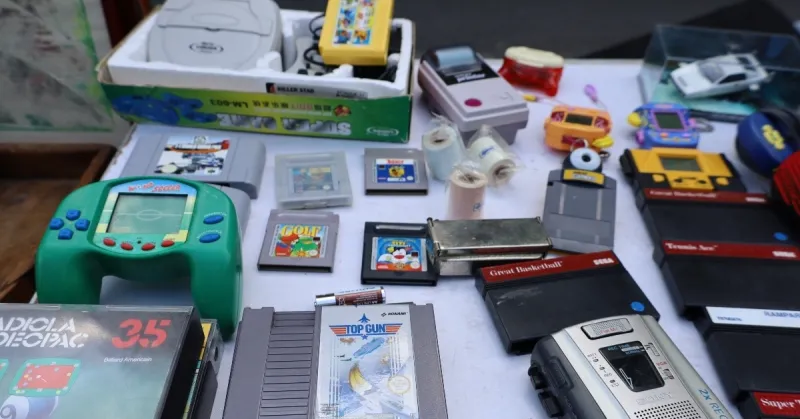
Resale shops and local game stores are often the first stop. Stores like retro-focused game shops — the kind you find tucked between a tattoo parlor and a pizza place in mid-sized American cities — see a steady stream of walk-in sellers bringing in collections of all shapes and sizes. The experienced buyers there have seen everything from complete-in-box SNES libraries to water-damaged Genesis carts that aren't worth the shelf space.
Online platforms like eBay, Facebook Marketplace, and increasingly, dedicated retro gaming Discord communities and subreddits, have become the go-to for sellers who want to maximize value without a middleman. A well-photographed lot of N64 games can move fast online, especially if the seller takes the time to list individual titles rather than dumping everything in a bulk lot.
Thrift stores get a surprising amount of donated games from people who either don't know the value or genuinely don't care. Goodwill, Salvation Army, and local church thrift shops remain one of the last frontiers for finding legitimately underpriced retro games — which is exactly why hardcore collectors treat thrifting like a sport.
Friends and family networks account for more collections than you'd think. Plenty of millennials pass their games directly to a younger sibling, a nephew, or a friend's kid who just got into retro gaming. It's less dramatic than a big eBay sale, but it keeps the culture alive in a grassroots way that's genuinely heartwarming.
What Collectors Are Saying
The collector community's feelings about this trend are, predictably, complicated.
On one hand, more supply hitting the market is good news for buyers. When a well-preserved collection goes up for sale, it creates an opportunity — especially for collectors who focus on complete sets or specific platforms. A single seller clearing out a childhood collection can fill gaps that took years to develop.
On the other hand, there's a bittersweet quality to watching collections get broken up and scattered. Longtime collectors often talk about the integrity of a collection — the idea that someone curated these games over years, that there's a story in the selection. When that gets split into individual lots and sold off piecemeal, something gets lost, even if each game finds a good home.
There's also a preservation concern worth taking seriously. Not every retro game that leaves an attic ends up with someone who knows how to care for it. Cartridges can end up in damp garages, direct sunlight, or just handled roughly by people who don't realize how fragile aging hardware can be. The retro gaming community has increasingly vocal advocates for proper preservation — both physical and digital — and a flood of newly available games isn't always a win if the games end up in worse condition than before.
What This Means for Retro Gaming Culture
Zoom out far enough, and this generational shift tells a story about where retro gaming culture is headed.
Millennials were the first generation to grow up with video games as a central part of childhood culture — not a novelty, not an arcade experience, but something that lived in their homes and shaped their identities. As that generation moves through adulthood, the relationship with those games evolves. Some people hold on tighter. Others let go entirely. Most end up somewhere in the middle, keeping a curated shelf of the games that actually meant something while clearing out the rest.
What's emerging from all of this is a kind of natural sorting process. The games and consoles that carry genuine cultural weight — the ones people actually connect with emotionally — are getting preserved and passed along with intention. The rest is cycling back into the market, getting picked up by the next wave of collectors who are discovering retro gaming for the first time.
That's not a bad thing. It's actually kind of how culture is supposed to work.
So if you're Marcus in that Ohio garage, staring at that shoebox of Game Boy carts — whatever you decide, you're part of something bigger than a cleanout. You're part of a living, breathing ecosystem that's been quietly keeping classic gaming alive for decades. Sell it, donate it, or keep it. Just know that somewhere out there, someone is going to be very glad you made a decision.
Even if it ends up at Goodwill.